



Please note: This website contains affiliate links. As an Amazon Associate, we earn from qualifying purchases at no additional cost to you.
You know that strange feeling when you read something ChatGPT helped you write and think:
“Well… technically it’s good.”
When I first started using ChatGPT to help write articles, I kept getting drafts that were perfectly fine on paper — accurate, organized, clear. But every time I read one, I’d hesitate before hitting publish. The content wasn’t bad. It just didn’t sound like me.
For a while, I assumed the problem was ChatGPT. What I eventually realized was that the problem was how I was using it.
I was treating it like a content vending machine. Type a prompt, get an article, hope it magically matched the voice inside my head. Of course it didn’t.
Everything changed when I stopped asking ChatGPT to write for me and started using it as a thinking partner.
I’d talk through ideas, explain my audience’s struggles, share half-formed thoughts that weren’t ready to become content yet. And the biggest shift came when I switched to the voice feature instead of typing — being able to ramble naturally meant ChatGPT finally had enough context to actually understand me.
The difference was remarkable (no exaggeration!). Not because the technology got smarter overnight, but because I stopped starving it of the thing it needed most: me.
That’s the real lesson. The goal isn’t to get AI to write like a human. It’s to help AI understand you well enough that it can help you express your ideas more clearly.
The secret isn’t finding the perfect prompt.
It’s learning how to collaborate.
The Real Problem: AI Doesn’t Know You Yet
When people talk about AI writing, the conversation usually goes in one of two directions. One group believes AI is ruining content. The other believes AI can write everything for them.
The truth is somewhere in the middle.
ChatGPT is incredibly good at organizing information, creating outlines, summarizing research, spotting gaps in content, and generating first drafts. What it can’t do is draw from your life experiences, your unique perspective, your sense of humor, or the lessons you’ve learned along the way. That’s why AI-generated content often feels polished but generic. The missing ingredient isn’t a better prompt. The missing ingredient is you.
Think of it like hiring an incredibly smart intern. They can research quickly, organize information, draft documents, and identify missing sections in your content. But they can’t understand your business, your audience, or the experiences that have shaped your perspective. That’s why handing AI complete control over your content rarely produces the best results.
Just as you would guide an intern, review their work, and add your own expertise, you need to approach AI as a collaborator rather than a replacement. The creators getting the best results from tools like ChatGPT aren’t using them to do all the thinking. They’re using them to organize ideas faster, explore different angles, and communicate their expertise more effectively. In that sense, AI isn’t replacing your creativity — it’s amplifying it.
Why Talking to ChatGPT Beats Prompting Every Time
One of the biggest misconceptions about AI is that success comes from finding the perfect prompt. If you’ve spent any time on YouTube, you’ve probably seen videos promising “The Ultimate ChatGPT Prompt” or “The One Prompt That Changes Everything.” In reality, conversation beats prompting almost every time.
Most people open ChatGPT and immediately ask it to write something. They type a short request, wait for a response, and hope the result is amazing. But AI works best when it has context — and context comes from conversation.
Before I ask ChatGPT to help me create an article, I spend time discussing the topic first. I’ll explain what my audience struggles with, why I think certain advice is wrong, what I’ve personally experienced, and what angle I want the article to take. Sometimes those conversations are messy and unorganized, but they help AI understand the thinking behind the content. By the time I ask for an outline or a draft, ChatGPT isn’t starting from scratch. It’s building on a conversation we’ve already had.
That simple shift — talking to AI before asking it to produce — can dramatically improve the quality of what it creates. And once you experience that difference, you’ll never go back to the one-line prompt approach again.
How to Help AI Actually Get to Know You (A 2-Step Process)
One of the most powerful things you can do before creating content is stop asking ChatGPT for output and start helping it understand who you are. These two steps are the foundation of everything — and most people skip both of them entirely.
STEP 01 | The Discovery Interview: Help AI Get to Know You First
One of the most powerful things you can do is stop asking ChatGPT for content and start helping it understand who you are.
Before creating articles, ask ChatGPT to interview you. You might be surprised by how much better your content becomes afterward.
Here’s the exact prompt you can copy and use today:
Discovery Interview Prompt (copy this)
I’d like you to interview me so you can better understand my writing style, personality, audience, experiences, and opinions.
Ask me one question at a time.
Your goal is to learn:
- My communication style
- My personality
- My audience
- My professional background
- My beliefs and opinions
- My sense of humor
- Stories and experiences I often reference
- Words and phrases I frequently use
- Words and phrases I dislike using
Once the interview is complete, create a detailed Author Voice Profile that you can reference when helping me create future content.
SIDE NOTE: The interview process might feel a little weird at first, but what comes out the other side is a profile that gives AI a real foundation to work from — one built on your actual words, not generic instructions.
STEP 02 | The Shortcut Most People Ignore: Share Samples of Your Writing
If you’ve already written blog posts, newsletters, emails, or social media captions, you already have the training material AI needs.
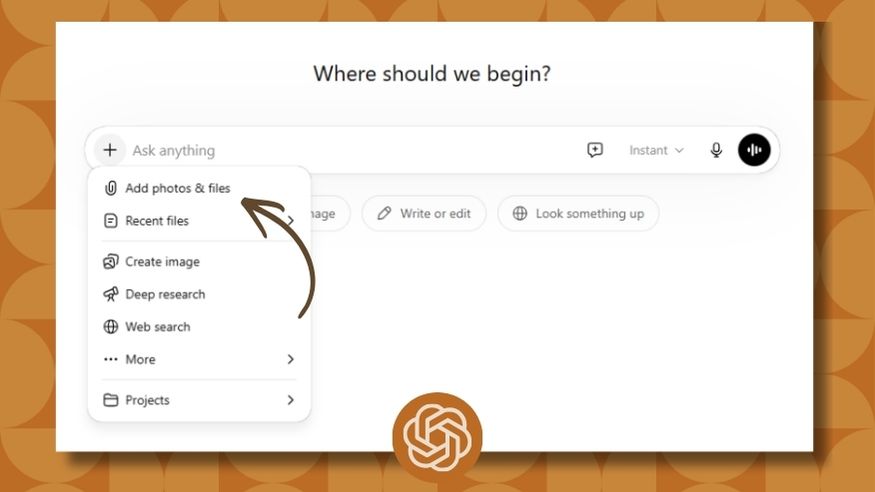
Upload examples of your writing and ask ChatGPT to analyze them. Rather than trying to explain your voice, you’re allowing AI to study actual examples of how you communicate. This almost always produces better results than simply telling AI you want your content to sound conversational, witty, or professional. You’re giving it evidence instead of instructions.
PRO TIP: If you don’t love your current writing style, you can upload examples from bloggers you admire instead — just make sure there’s a consistent theme and personality so ChatGPT doesn’t get confused trying to blend too many different voices.
Your Job: Add What AI Can Never Know
AI is fantastic at creating the framework of an article. It can organize information, suggest sections, improve readability, and speed up the drafting process. But the most memorable parts of any piece of content almost always come from a person.
The stories. The hard-won lessons. The mistakes you made so your reader doesn’t have to. The opinions that make someone nod along and think “yes, exactly.” The moments that make a reader feel genuinely understood — those can’t be generated. They have to be lived.
Whenever I create content with AI, I ask myself one question before I hit publish: “What can I add that AI could never know?”
The answer is usually where the best part of the article begins.
It might be a personal anecdote that perfectly illustrates the point. It might be a contrarian opinion you actually believe. It might just be the way you’d explain something to a friend over coffee.
Whatever it is, that’s your job. AI writes the skeleton. You add the soul.
How to Tell If Your Voice Is Still Missing
If something feels off when you’re reading your draft, trust that instinct. Here are the most common signs that your content still sounds too much like AI — and what to do about each one:
- No personal stories or real-world examples. If the article could apply to anyone, it probably won’t resonate with anyone. Add at least one specific experience, even a small one, that grounds the advice in reality.
- Generic advice anyone could give. If your content doesn’t reflect your actual opinions or experiences, it blends into the sea of everything else online. Ask yourself: what do I actually think about this? Then say it.
- No personality or point of view. Overly polished, balanced, neutral writing is forgettable. Your quirks, your humor, your way of phrasing things — that’s what keeps readers coming back.
- Repetitive sentence structures. AI tends to build sentences in very similar patterns. Read your draft out loud and anywhere it sounds monotonous, rewrite it the way you’d actually say it.
If your article could be published under almost anyone’s name, it’s missing your voice. The good news is that’s always fixable — and it usually only takes one honest pass through the draft to bring it back to life.
Final Thoughts
If you’re still feeling a little uneasy about using AI in your writing, that’s actually a good sign. It means you care about your work, your readers, and the value you’re providing.
The good news is that you don’t have to choose between authenticity and efficiency.
When AI has enough context about your experiences, opinions, audience, and writing style, something shifts. Instead of sounding like something generated by a machine, the content starts to feel like your ideas organized more clearly, your experiences explained more effectively, and your expertise communicated with greater confidence.
The best creators aren’t using AI to replace themselves. They’re using it to think better, organize faster, and communicate more clearly.
Because at the end of the day, ChatGPT isn’t the author.
You are.
SHARE THIS WITH YOUR BLOGGER FRIENDS!
Text Overlay
Using ChatGPT But It Doesn’t Sound Like You?
How to Keep Your Voice While Using AI
Pinterest Title
How to Use ChatGPT Without Losing Your Voice | Writing Tips
Pinterest Description
If your AI-generated content feels polished but somehow doesn’t sound like you, you’re not imagining it. Learn how to use ChatGPT as a thinking partner instead of a content machine. These writing tips will help you create blog posts, content, and articles that still reflect your personality, experiences, and unique perspective. Perfect for bloggers, content creators, and small business owners looking to improve their content creation process.
Blogging Tips + Content Creation
Text Overlay
The Secret Isn’t Better Prompts
It’s Better Conversations
Pinterest Title
Blogging Tips: Why Talking to ChatGPT Works Better Than Prompting
Pinterest Description
Most bloggers spend hours searching for the perfect ChatGPT prompt. What if the real secret is having better conversations instead? Learn how to use AI to brainstorm ideas, improve your writing process, and create stronger blog content without sounding robotic. A must-read for anyone looking for blogging tips, blog writing tips, and smarter content creation strategies.
PIN SET #3
Search Intent:
Content Creation + Content Writing Tips
Text Overlay
AI Writes Faster.
You Make It Better.
The Missing Piece Most Creators Ignore
Pinterest Title
Content Creation Tips: How to Make AI Content Sound Human
Pinterest Description
AI can help you write faster, but your stories, opinions, and experiences are what make content memorable. Discover how to blend AI efficiency with your authentic voice using practical content writing tips and content creation strategies. Great for bloggers, writers, and creators who want to use ChatGPT without losing what makes their content unique.
Bonus Pin (My Favorite)
This one is a little more curiosity-driven and very Pinterest-friendly.
Text Overlay
Why I Almost Stopped Using ChatGPT
The Problem Wasn’t AI
Pinterest Title
The Biggest ChatGPT Mistake Bloggers Make
Pinterest Description
When I first started using ChatGPT, the articles were organized, readable, and technically good—but something felt off. Learn the simple shift that transformed the way I use AI for blogging and content creation. If you’ve ever struggled to make AI-generated content sound like you, this article will completely change how you think about writing with AI.
This last one is probably the one I’d test first because it leans heavily into the personal story and creates a strong curiosity gap while still fitting naturally within the Bloom Digital brand.
Please note: This website contains affiliate links. As an Amazon Associate, we earn from qualifying purchases at no additional cost to you.